
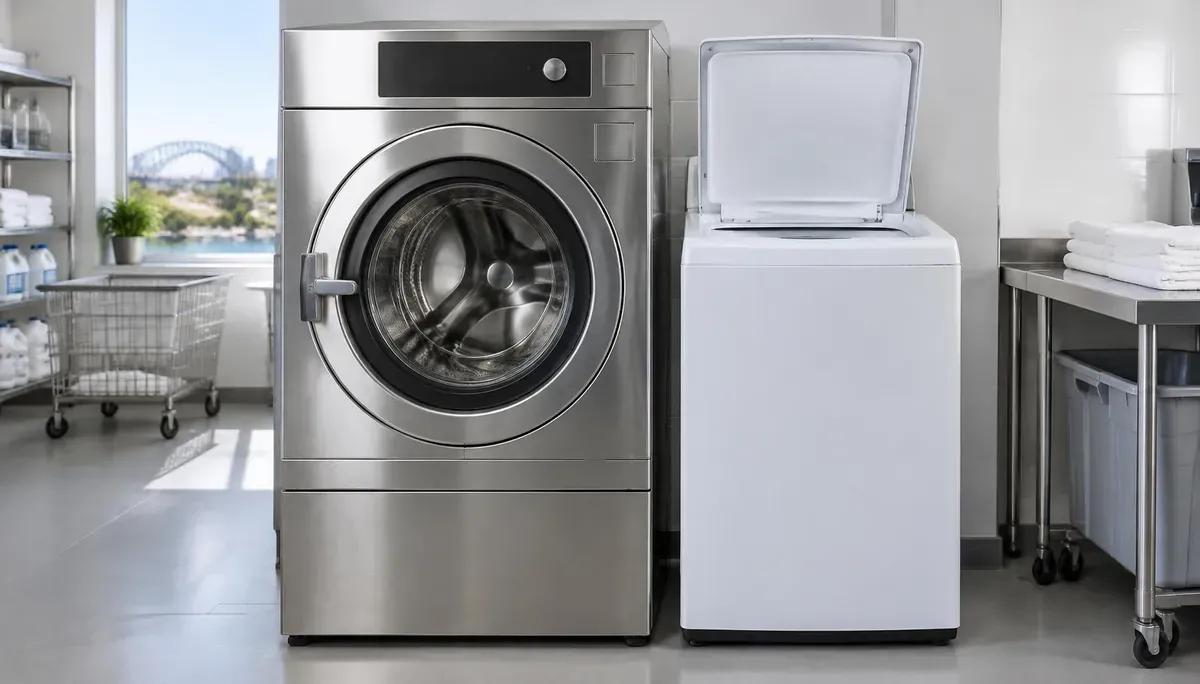
The front load versus top load question looks like a preference. In a business laundry it is an operating cost decision. The two designs move linen through water in completely different ways, and that difference shows up in your water bill, your drying time and how long your linen lasts.
How each design actually washes
A top loader fills a tub with water and moves the load against an agitator or impeller. A front loader tumbles the load through a shallow bath of water, lifting and dropping it against the drum. Tumbling needs far less water to get the same mechanical action, and it is gentler on fibres because nothing is being dragged around a central post.
| Factor | Front load | Top load |
|---|---|---|
| Water per cycle | Low, the drum only needs a shallow bath | High, the tub is filled to cover the load |
| Wash quality | Better on heavy soil, more consistent chemical contact | Adequate on light soil, agitation does the work |
| Extraction | Very high, 350 to 450 G on commercial models | Low, typically under 200 G |
| Drying time after wash | Shorter, less water left in the load | Longer, the dryer removes what the spin did not |
| Fabric wear | Gentle, tumbling action | Higher on agitator models |
| Purchase price | Higher | Lower |
| Running cost | Lower on water, energy and drying | Higher across the life of the machine |
| Ergonomics | Bending to load, unless on a plinth | Waist height loading |
Extraction is the number people miss
Extraction, measured in G force, decides how much water leaves in the spin rather than in the dryer. Drying is the expensive half of a laundry, so a machine that spins harder saves money on every load. A commercial front loader at 400 G leaves linen far drier than a top loader at 150 G, and that difference compounds across thousands of cycles a year.
Indicative water use per wash cycle
Relative water use for a comparable load. Actual figures depend on model, program and load size.
Commercial front load: 34% | Domestic front load: 45% | Impeller top load: 78% | Agitator top load: 100%
Where a top loader still makes sense
- A small shared living or staff laundry with a handful of loads a week.
- Sites where users cannot bend to a front loading door and a plinth is not possible.
- Temporary or low budget setups where purchase price outweighs running cost.
Outside those cases the numbers favour front load. Once a machine runs more than a few cycles a day, the water, energy and linen replacement savings pay back the higher purchase price well inside the life of the machine.
What to specify on a commercial front loader
- Extraction of at least 350 G if you want real drying savings.
- Soft mount if the floor cannot take the load of a bolted hard mount machine.
- Programmable controls so you can set wash temperature and chemical dosing per load type.
- Cycle logging where infection control needs to be verified, such as aged care and healthcare.
- A door height and plinth that suit the people loading it every day.
If you are weighing this up as part of a wider fit out, the wash temperature you run and the dryer you pair the washer with will move your operating cost just as much as the load type does.