
Two commercial washers of the same stated capacity can differ in price by a factor of three. The specification sheet almost always explains why. Understanding the handful of variables that move the number is the difference between buying well and buying twice.
Start with build class, not capacity
Capacity is the obvious variable and the least useful one for understanding price. A 20kg machine is not simply twice the price of a 10kg machine, because the frame, bearings, motor and control system do not scale in a straight line with drum size. The step that matters far more is build class, and it shows up as expected cycle life.
Expected cycle life by machine class
Approximate design life in wash cycles. At five cycles a day, 30,000 cycles is roughly sixteen years of service.
Domestic: 2500 cycles | Light-commercial: 10000 cycles | Commercial: 30000 cycles | Industrial: 60000 cycles
This is why a domestic machine in a commercial setting is a false economy. It is not that it cannot do the work, it is that the number of cycles it was designed for will be consumed in months rather than years, and there is no meaningful parts or service pathway behind it.
Extraction is the biggest value driver
Extraction force, expressed in G, determines how much water remains in the linen at the end of the wash. Every litre left behind has to be evaporated by the dryer, and evaporation is expensive. A high extraction machine costs more to buy and less to run, and on a busy site the difference is not marginal.
Residual moisture and dry time by extraction force
Indicative figures for cotton flatwork. Lower residual moisture means shorter dryer cycles and lower gas consumption.
100G: Residual moisture (%) 68, Relative dry time (%) 100 | 200G: Residual moisture (%) 58, Relative dry time (%) 85 | 300G: Residual moisture (%) 52, Relative dry time (%) 76 | 400G+: Residual moisture (%) 45, Relative dry time (%) 66
There is a second, less obvious benefit. Soft-mount machines that achieve high G do not require the concrete plinth that hard-mount machines need, which can remove a meaningful installation cost and makes upper-floor and retrofit installations far simpler.
Heating method follows the building
Commercial washers heat with electricity or steam, so the heating choice follows what the building already has. Electric heating is the simplest to install and suits most sites. Steam is efficient where a boiler already exists and is common in hospitals, large hotels and central laundries. None of these is universally better, which is why a credible quote follows a site assessment rather than preceding it.
| Heating | Install cost | Running cost | Best suited to |
|---|---|---|---|
| Electric | Lowest | Higher unless solar offset | Small to mid sites |
| Steam | Highest without a boiler | Lowest with an existing boiler | Hospitals, large hotels, central laundries |
Controls, connectivity and compliance
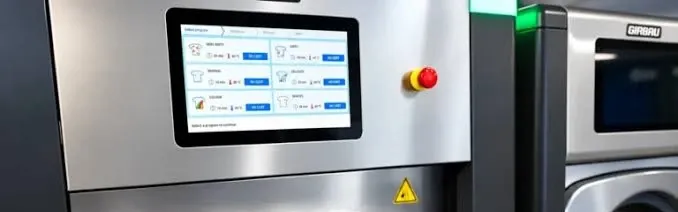
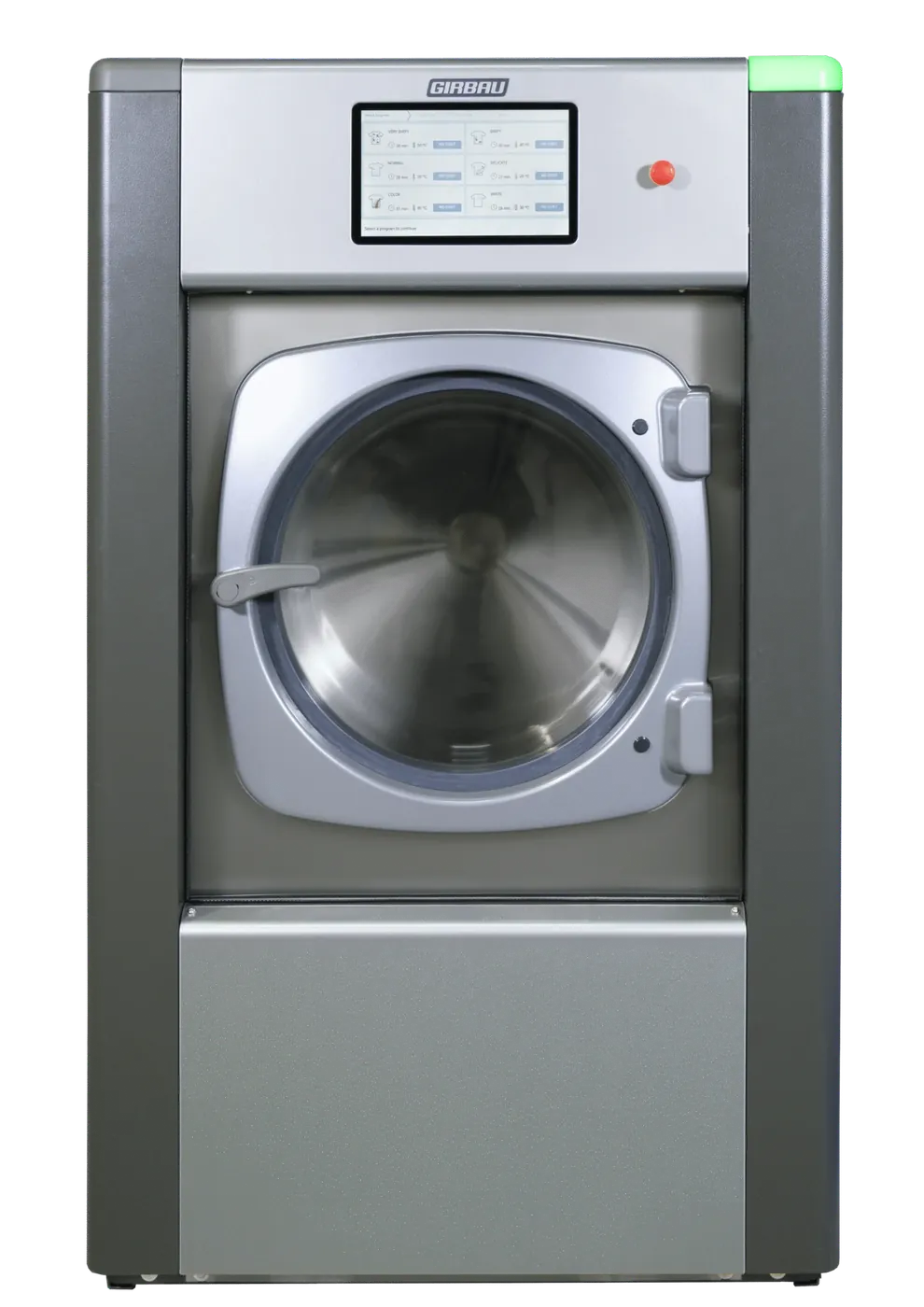
A basic programmable control is enough for a simple linen operation. A connected touch-screen control earns its cost where the interface matters: the display is simple and easy to read at a glance, so any operator can select the right cycle without hunting through menus, and new staff need only a few minutes of instruction rather than weeks of supervision. That ease of use keeps every operator, from the most experienced to the newest starter, getting the most out of the machine. For managers, the same screen carries documented thermal disinfection, multiple programs across shifts, and the ability to push a cycle change to every machine at once. In aged care and healthcare that reporting capability is frequently the reason the installation is compliant at all, so it belongs in the specification rather than in the nice-to-have column.
How to compare quotes fairly
Before comparing prices, normalise the quotes. Two numbers are only comparable when they cover the same scope.
- Delivery, rigging and placement, including any crane or stair access.
- Plinth or base works for hard-mount machines.
- Electrical, water and drainage connection, and who holds the licence.
- Commissioning, programming and staff training.
- Warranty term, what it covers and who performs the work.
- Parts availability in Australia and typical response time in your city.
A machine that is fifteen percent cheaper and two weeks away from a spare part is not cheaper. In a laundry, downtime is not an inconvenience, it is outsourced linen and overtime.