
Drying is where a laundry's energy bill is won or lost. Washing uses water and a modest amount of power. Drying converts energy into evaporation, and the amount of energy required is set largely by how much water is still in the linen when it enters the dryer. That is why dryer selection starts with the washer, not the dryer.
Energy in a laundry, by function
Where a typical on-premise laundry's energy goes
Indicative split for a mid-size OPL with gas dryers. Drying dominates in almost every configuration.
Drying: 58% | Water heating for washing: 24% | Ironing and finishing: 12% | Motors, controls, lighting: 6%
Because drying is the largest slice, small improvements there outperform large improvements anywhere else. The most effective single change is not the dryer at all, it is specifying a washer that extracts more water before the load is transferred.
Size the pair together
A common and costly mistake is matching washer and dryer capacities exactly on paper, then discovering the dryer runs two cycles for every wash. Dryers need volume as well as weight capacity, because linen expands when it tumbles. Size the dryer at or slightly above the washer, and remember that a high-G washer effectively increases the throughput of every dryer behind it.
| Washer capacity | Recommended dryer | Notes |
|---|---|---|
| 11kg | 11kg to 14kg | Small OPL, medical, hospitality back of house |
| 18kg | 18kg to 25kg | Aged care, hotels, mid-size accommodation |
| 27kg | 27kg to 35kg | High volume OPL, larger accommodation |
| 45kg+ | Two matched dryers | Splitting load allows staggered unloading and continuous flow |
Gas, electric or heat pump
Comparing the three heating types
Indexed comparison where 100 is the highest in each category. Higher is worse for cost and time, higher is better for efficiency.
Gas: Capital cost 70, Running cost 55, Cycle time 60 | Electric: Capital cost 55, Running cost 95, Cycle time 75 | Heat pump: Capital cost 100, Running cost 45, Cycle time 100
Gas
Gas dryers remain the workhorse for volume laundries in Australia. They heat quickly, recover fast between loads and generally offer the lowest cost per kilogram of linen dried where natural gas is available. The trade-offs are the gas connection itself, flueing requirements and a service regime that includes the burner and gas train.
Electric
Electric dryers suit smaller sites, buildings without gas, and installations where flueing is impractical. They are simpler to install and service, but running cost per load is usually higher unless the site has solar generation to absorb during the day, which is increasingly common on aged care and accommodation sites that run their laundry in daylight hours.
Heat pump
Heat pump dryers recover heat rather than exhausting it, which makes them genuinely efficient and removes the need for a flue. They suit sites with steady rather than peaky volume, tight ventilation constraints, or an emissions target. Cycle times are longer than gas, so the capital premium is recovered over a long ownership period rather than quickly.
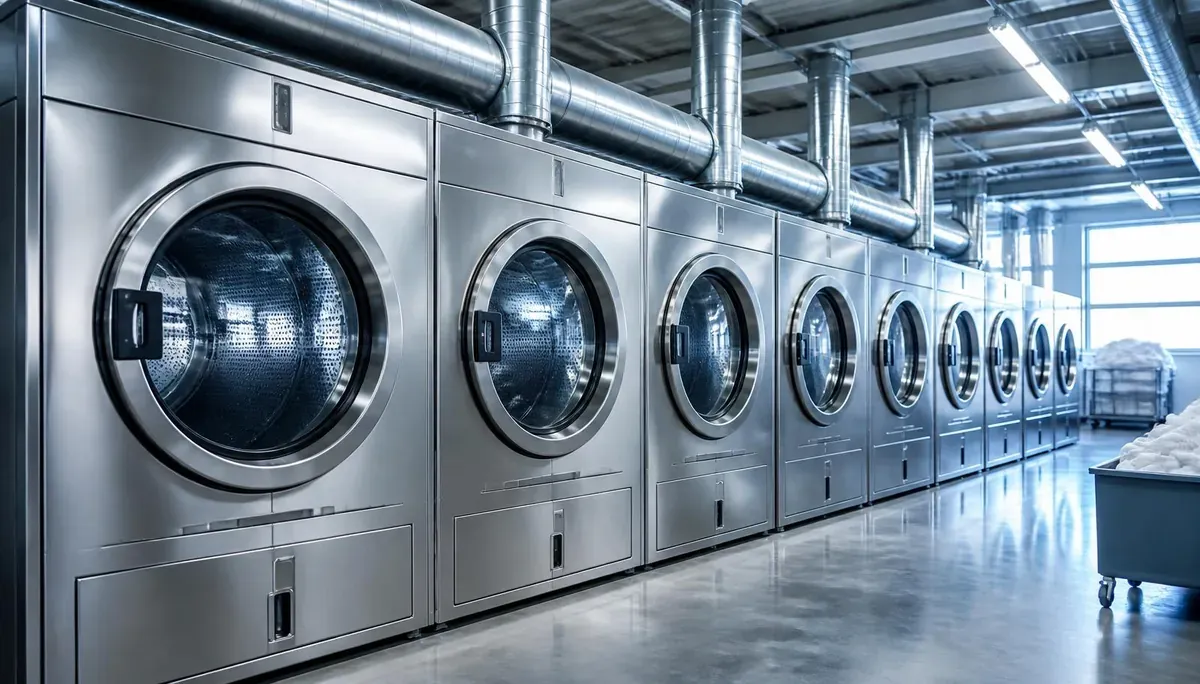
Ventilation is not a detail
Restricted ducting is the most common cause of long dry times, high energy use and premature component failure, and it is also the leading fire risk in a commercial laundry. Adequate make-up air matters as much as the exhaust path, because a dryer that cannot draw air cannot dry efficiently no matter how much heat it produces.
- Keep duct runs as short and straight as the building allows, and minimise elbows.
- Match duct diameter to the manufacturer's specification rather than to what is already in the wall.
- Provide dedicated make-up air into the laundry, sized for the total dryer load.
- Schedule lint path cleaning as a documented routine, not an occasional job.
- Never share a duct between dryers unless the manufacturer explicitly permits it.