
Volume
Milnor positions the CBW for laundries processing at least 363 kg (800 lb) of linen an hour. Below that, the investment is hard to justify.
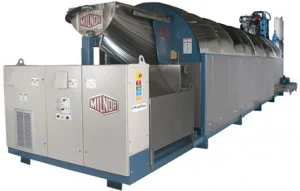
Continuous batch washers
Wash tonnes of linen every shift while using a fraction of the water of conventional washers.
Getting the fit right
Milnor positions the CBW for laundries processing at least 363 kg (800 lb) of linen an hour. Below that, the investment is hard to justify.
Tunnels suit steady streams of similar goods, such as sheets, towels, table linen and uniforms, that can be sorted into consistent batches.
A tunnel is long and narrow. You need a clear run for the modules, plus room for loading, a press or extractor and dryers.
Lots of small, mixed or specialty loads? A bank of washer-extractors is often the better choice.
Not at tunnel volumes yet? Look at the Milnor MWF Series suspended washer-extractors, 45 to 125 kg per load.

The process
Every module repeats the same four steps. Goods move forward towards cleaner water while water flows back towards the dirtiest goods, so the last water your linen meets is fresh.
A batch of soiled linen is loaded into the first module and wetted out quickly.
For about 70% of each cycle the water stays still around the goods, so chemicals work at full strength instead of being diluted by flowing water.
A short, high-velocity rinse flows backwards through the module, carrying soil and spent chemical away from the goods.
True Top Transfer lifts the goods up, lets free water drain away, then slides them into the next, cleaner module.
True Top Transfer
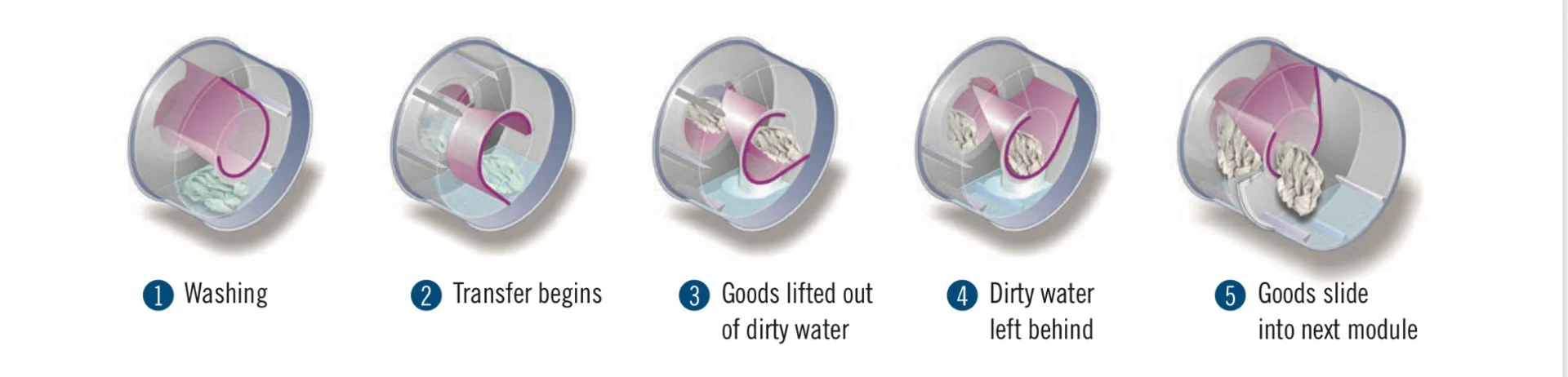
Proven in more than 1,000 installations worldwide. A perforated scoop lifts each batch out of its bath and drops it into the next module, so there is no stopping to drain and refill between baths. Better dilution means better soil removal and faster washing than other tunnel designs.
Water isn't pumped forward with the goods, so every bath stays independent and chemicals stay where the formula puts them. They don't drift into later baths, which makes pH far easier to control.
A variety of arrangements
Every CBW is configured for the laundry it goes into. Add modules for more output, and place water inlets, drain valves, steam and chemical supply exactly where your formulas need them.
A conveyor or overhead bag system feeds the load chute.
The operator enters a goods classification number. The matching formula then follows that batch all the way to unloading from the dryer and on to finishing.
Each module has a fixed shell holding the bath and a perforated inner cylinder that turns. Any module can run a different bath.
Any module can be fitted with a steam inlet and temperature probe.
Supply inlets can go in any module. Mentor decides how much is added, when, and whether it is added at all for each batch.
MultiTrac passes each batch's needs to the extractor, shuttle, dryers and conveyors, shows where every batch is, and stops incompatible batches sharing a dryer.
Benefits
Water use can be as low as about 2.5 L/kg (0.3 gal/lb) for lightly soiled linen, and around 4 L/kg (0.5 gal/lb) for most heavy soil.
Standing baths let chemicals do their job, and solid welded partitions keep each bath separate. RecircONE wets goods out fast in module one, and ChemRatio matches chemical dosing to the weight of each load.
Less water means less to heat. The system suits low-temperature chemistry, runs inverters on its drives and pumps, and can be specified with steamless heating.
Top transfer washes roughly 30 to 40% faster than bottom-transfer tunnels. That means fewer modules, a shorter footprint and no separate rinse modules.
Construction
A tunnel runs for years, shift after shift. The CBW is engineered around that, and its wash performance is independently tested and Hohenstein certified.
Controls
The controller at the machine.
Oversight across the whole laundry.
The complete system
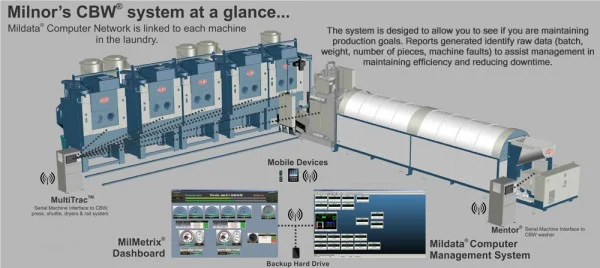
Each piece talks to the next, so batches move through without waiting. See the wider Milnor range.
Models and sizes
| Model | Construction | Capacity per batch | Drum diameter | Drum depth | Width | Height |
|---|---|---|---|---|---|---|
| 76028 | Sectional (sections of 3, 4 or 5 modules) | 50 kg (110 lb) | 1,930 mm (76 in) | 711 mm (28 in) | 2,311 mm (91 in) | 2,755 mm (108.5 in) |
| 76039 | Sectional (sections of 3, 4 or 5 modules) | 68 kg (150 lb) | 1,930 mm (76 in) | 990 mm (39 in) | 2,311 mm (91 in) | 2,755 mm (108.5 in) |
| 92048 | Modular (each module has its own drive) | up to 120 kg (up to 260 lb) | 2,337 mm (92 in) | 1,219 mm (48 in) | 2,572 mm (101.3 in) | 3,290 mm (129.5 in) |
| Modules | 76028 | 76039 | 92048 |
|---|---|---|---|
| 3 | 5,440 mm (17.8 ft) | 6,160 mm (20.2 ft) | 7,530 mm (24.7 ft) |
| 4 | 6,220 mm (20.4 ft) | 7,180 mm (23.6 ft) | 9,110 mm (29.9 ft) |
| 5 | 7,000 mm (23 ft) | - | 10,680 mm (35 ft) |
| 6 | 8,340 mm (27.4 ft) | 9,770 mm (32.1 ft) | 12,260 mm (40.2 ft) |
| 7 | 9,120 mm (29.9 ft) | 10,790 mm (35.4 ft) | 13,840 mm (45.4 ft) |
| 8 | 9,900 mm (32.5 ft) | 11,820 mm (38.8 ft) | 15,420 mm (50.6 ft) |
| 9 | 10,680 mm (35 ft) | 13,380 mm (43.9 ft) | 16,990 mm (55.7 ft) |
| 10 | 11,460 mm (37.6 ft) | 14,400 mm (47.2 ft) | 18,570 mm (60.9 ft) |
| 11 | 12,800 mm (42 ft) | 15,420 mm (50.6 ft) | 20,150 mm (66.1 ft) |
| 12 | 13,580 mm (44.6 ft) | 16,440 mm (53.9 ft) | 21,720 mm (71.3 ft) |
Specifications and appearance subject to change without notice. Every tunnel is configured to the site; our team will size it with you.
Watch
PulseFlow Technology Explained
Why Aqualogic
We plan the room around how linen moves, from soiled to folded.
One team coordinating trades, services and timelines.
Our own technicians install, connect and commission the line.
Your team learns to run, load and look after the system.
Maintenance plans, fast repairs and genuine parts.
Spread the investment with finance to suit your business.
Talk to our laundry design team
Tell us about your volumes, linen mix and site. We'll work out whether a tunnel suits you and how it should be configured.